Tuesday, August 20, 2019

Small-Town Memories; Small-Town Future. Part 2: Welcome to Michiana-Plus.

The White Pigeon train depot, from a time long past.
Image: michiganrailroads.com.
When you grow up in a small town -- as I did, in little White Pigeon, Michigan, current population around 1,500 -- you either find ways to entertain yourself, or you get in your car and drive. Likewise with shopping. Either you deal with what the local mom-and-pop has for sale, or you plan a trip out of town. Every little village might have something different that you're looking for, so you get to know the surrounding areas and what they offer pretty well. Maybe things are different now, when Amazon can deliver anything to your door, but back in the '70s and '80s -- before the internet, before cell phones -- this was reality in small-town America. Whatever was nearby was what you got.

For us, if we needed a loaf of bread, we could pop uptown to the grocery store. If we needed something only a department store was likely to have, then it was north to Three Rivers (about 10 miles) or south to Elkhart, Indiana (20 miles). But for the full mall experience, we had to venture out even further -- north to Portage or Kalamazoo (30 to 35 miles), or south to Mishawaka and South Bend (35 to 40 miles). Better make sure your car is fueled up and in good shape. Hope the winter's salt hasn't rusted out the body too much.

Trips to the big, big city didn't happen too much, and they usually weren't for necessity shopping -- just a fun day out. Our big city was Chicago, about 120 miles west. We never really thought about going to Detroit, about 165 miles east, or even Grand Rapids, just 85 miles or so north. I'm not sure why. We just felt more connected to Chicago and northern Indiana. Maybe it was because my parents' families mostly lived in both places.

But with White Pigeon situated only three miles from the state line, we definitely felt more like residents of "Michiana" than true Michiganians. I traveled US-12, US-131, M-40, M-51, M-60, M-103, and I-94 around southwest Michigan, but I also spent a lot of time on SR-13, SR-15, SR-120, and the 80/90 Toll Road in Indiana. Our family went to Mass at St. Joseph's in White Pigeon and Immaculate Conception in Three Rivers, but also St. Vincent's in Elkhart and St. Mary's in Bristol, on the Indiana side. I went to school in Michigan but worked in Indiana. I called White Pigeon home, while most of our relatives lived around Bristol and Goshen, down in Indiana. We were two-state people, and that never got crazier than when Michigan went on daylight-saving time and Indiana didn't. Half the year we'd all be on the same time; the other half we'd have to do the math to figure out what time we were going to meet friends and relatives ("Is that 5 your time or 5 our time?") and when we had to leave for work, church, and everything else.

Such was life straddling the border of two states.

Life in Michiana-Plus

"Michiana" is a popular term that media folks and the business community use to describe the region that's centered on South Bend, the largest city -- current population a smidge over 101,000. The boundaries of Michiana are somewhat fluid but usually don't extend north to Kalamazoo, which is typically associated with the region simply known as West Michigan, or sometimes Southwest Michigan. So since Kalamazoo was a significant part of my life even as I identified with the Michiana area, I'll just make up my own term and call the area that was the center of my existence "Michiana-Plus." I got my college education in Kalamazoo and my first two steady jobs in South Bend, so there's no way I could leave either one out when talking about the area I called home.

Getting back to South Bend for a moment -- it was so named because it sits at the southernmost bend of the St. Joseph River, which features prominently throughout Michiana, flowing through many of its towns and cities. Its importance to the region is reflected in the fact that two counties bear the name St. Joseph -- one in Indiana, where South Bend is located, and the other in Michigan, where I grew up in White Pigeon. There's also a city of St. Joseph in Berrien County, Michigan, on the shore of Lake Michigan.

With all this talk of saints, you'd think that Catholics had a hand in settling the Michiana area -- and you'd be right. But as I'll discuss, they weren't the only ones -- and of course the Indians were there first, mainly the Potawatomi and Miami peoples. Their legacy lives on primarily through many of the place names in Michiana, from Mishawaka to Shipshewana.

So let's take a little tour of the region I hail from, peppered with some fun facts. The first 32 years of my life revolved around Michiana-Plus -- St. Joseph, Cass, Berrien, Kalamazoo, and Van Buren counties in Michigan; and Elkhart, St. Joseph, LaGrange, and Kosciusko counties in Indiana -- so I know the lay of the land pretty well. Still, I admit I don't know everything, and in the past 16 years I've only been back to visit two or three times. So my memories are just that -- memories -- though I'm fairly confident that there haven't been any drastic changes in the intervening years. 

Corn, corn, and more corn
The house I grew up in was literally surrounded by corn fields. It sat on a small plot with fields on all four sides. Corn is a huge business where I come from; in fact, just up the road from my hometown of White Pigeon, in neighboring Constantine (2010 population 2,116), you'll find the world's two largest seed-corn processing plants side by side.

Corn is a billion-dollar business in my old stomping grounds, and even the kids get to share in the wealth, with summer jobs out in the fields. Detasseling is practically a rite of passage for teenagers where I come from. It's a simple enough job -- you just have to yank the pollen-producing tassels off the top of the corn stalks so that they won't fertilize the silk on their own cobs. The idea is to get the corn to cross-pollinate with a second variety that shares the same field, resulting in a hybrid of the two species. Hybrids are desirable because they produce higher yields and tend to be more resistant to drought and disease.

So what happens to all this corn? As a kid, I always thought the corn got shipped over to nearby Battle Creek to make Kellogg's Corn Flakes. Instead, our corn is grown to be seed corn. It's sorted, dried, husked, and packaged as seeds for other farmers to plant.

Over in South Bend, an ethanol plant gobbles up a lot of corn every year. As of 2018, the plant made 65 million gallons of ethanol a year.

The lake and lighthouse at South Haven.
Image: TripAdvisor.
A gigantic lake and a pretty big Whirlpool
Whenever I think of any of the towns in Western Berrien County, I think of Lake Michigan. They all border the Great Lake that defines the western border of Michiana, and their beaches, lighthouses (at New Buffalo and St. Joseph), and sand dunes (notably Warren Dunes, near Bridgman) attract thousands of locals and tourists alike every year.

Growing up not far from the lake, I was asked more than once if you could see Chicago on the other side. In a word, no. The Great Lakes are so massive that it's almost impossible to appreciate their size without seeing them. When you're sitting on their shores, you can easily imagine yourself relaxing by the ocean. So how big is Lake Michigan? Well, at 22,394 square miles, it could hold the smallest five U.S. states by size -- Rhode Island, Delaware, Connecticut, Hawaii, and New Jersey -- combined. Or it could comfortably accommodate the entire nation of Costa Rica, with room to spare.

Then there's the Benton Harbor area, which brings up a fun fact: Michigan makes more than just cars. The world headquarters of Whirlpool, the planet's largest maker of home appliances, is located in Benton Charter Township, adjacent to Benton Harbor.

Homegrown wine. Image: southhaven.org.
Everything you need for a sangria
West Michigan is known for its many orchards and "U-pick" farms. Apples and cherries are especially abundant, and you'll find lots of peaches and blueberries, too. You can get gallons of fresh-pressed apple cider just about everywhere when autumn arrives.

We also have lots of vineyards, and vineyards mean wineries. The award-winning St. Julian Winery, Michigan's oldest and largest winery, was the best known to me and definitely one of the state's most popular.

Paw Paw? Colon?
From Leonidas to Climax, we have some funny place names in the region. The aforementioned St. Julian Winery is headquartered in Paw Paw, named for the pawpaw fruit trees that used to grow there. The Van Buren County seat, population 3,534 as of 2010, also enjoyed a brief moment of fame courtesy of 19th-century resident A.W. Underwood, who was said to possess the ability to breathe fire. Brian Eno immortalized Underwood in his 1974 song "The Paw Paw Negro Blowtorch."

Then there's Colon. Yep. Colon. The St. Joseph County village got its name when one of the town's founders opened a dictionary and his eyes fell on the word "colon." Maybe he should have gone for the best of three, but for better or worse, the name stuck.

Presto! Image: magic-festival.com.
Fortunately, Colon -- 2010 population 1,173 -- is not known for colons, but for magic. In fact, it's known as the Magic Capital of the World, and it may just be able to live up to that boast. Harry Blackstone Sr. made Colon his summer residence, and ever since then the town has been a magnet for all things stage magic. Some 30 magicians are buried in Colon's cemetery, an annual magic convention draws practitioners from around the world, and the town is home to several magic supply shops, most notably the Abbot Magic Company. Even the public school system's sports teams have gotten in on the spirit: Their nickname is the Magi.

And what's the deal with Elkhart and Kalamazoo?
No one knows with absolute certainty where the name Elkhart (2010 population 51,860) came from, but the best-known story is that it took its name from an island at the convergence of the St. Joseph and Elkhart rivers. That island is supposedly shaped like the heart of an elk. I don't know exactly how an elk's heart looks distinctly different from the heart of any other animal, but there you go.

Image: mlive.com.
Kalamazoo (2010 population 74,262) might be one of the most fun place names to say of all time. It's been the subject of many a song and has lent its name to trains and ships alike. But, again, no one really knows where the name came from, though most stories agree that it derives from an Indian word. One legend says that an annual Potawatomi tradition involved a footrace in which the men had to run from the settlement to a point on the nearby river and back before a pot of water boiled away. The white settlers presumably latched on to the word for "boiling pot," kikimasung, and a city's name was born. Maybe.

The first concert I ever attended was in Kalamazoo. I went to see Yes, at what was then called Wings Stadium, on their 1991 tour. And I remember vividly that singer Jon Anderson, in his banter in between songs, took a moment to ruminate on the name "Kalamazoo," before blurting out "Oozamalak!" It took me a minute to figure out what he was saying, and a moment later he announced to the crowd, "Sounds better backwards!" Some people in the crowd booed -- playfully, I hope! -- but it made me crack up. My wife and I still refer to the city as Oozamalak sometimes. It does sound pretty cool -- kind of like a faraway planet in a sci-fi novel. Thank you, Jon Anderson.

Image: hippostcard.com.
Opera in the middle of nowhere
You wouldn't expect to find an opera house in a small town in northern Indiana. Yet there it is -- Bristol Opera House, which opened its doors way back in 1897. I know Bristol best as the place where my Grandpa and Grandma Rush lived, but this historic building in a sleepy little Elkhart County town (2010 population 1,602) continues to entertain the public today, though opera has given way to popular stage plays.

Al Capone in Purgatory
Rumors have swirled for years that Al Capone had a secret residence somewhere in southwest Michigan. The most persistent rumor is that his hideout was in a remote area between Three Rivers and Jones called Purgatory. No one seems to know how Purgatory, now a state game and hunting area, got its name, but it's a scrubby patch of ground in the middle of nowhere, and as such it certainly would have made a good place to lie low if you're a notorious mob boss, since no one would ever deliberately go there looking for anything. Today there's not much in Purgatory but the old foundations of long-gone buildings. It's also a popular place for ghost-hunters. The legend of Goat-Man and his Devil Dog companion has been lurking around in the shadows of local lore for a long time.

Be careful what you wish for. Image: Wikipedia.
Constantine is Radiator Springs
In the Pixar movie Cars, Sally Carrera laments how the interstate bypass left her town, Radiator Springs, forgotten and neglected. Now the traffic simply sped by, in a hurry to get somewhere else, rather than taking in the charm of the small towns along the way. Meanwhile, in real life, some residents of Constantine had for years and years complained that US-131, one of the major highways through my old stomping grounds, needed to be rerouted around town. The truck traffic that trudged through the downtown district shook the historic buildings, doing damage to their foundations.

I remember the debate well, as a home my parents owned in Constantine was in danger of being demolished for the bypass, if it were ever to be built.

Well, the people of Constantine finally got their way, and the bypass became a reality. The new path it cut across former farmland managed to spare my parents' house by about a quarter-mile, but the effect in Constantine was predictable. Downtown traffic slowed to a trickle, and those who may have stopped to shop or grab a bite to eat at Harvey House or the Chicken Coop or the Town Fryer zoomed on to their next destination. Last time I went home for a visit, there were boarded-up storefronts galore in Constantine. The residents got their wish -- but at what price?

The humpy-bumpy bridge, as my wife used to call it.
Image: Wikimedia.
Mottville: Blink and you'll miss it
Mottville holds five distinct memories for me: junior high, the speedway, the time my car caught on fire, the camelback bridge, and the Olympic torch.

Back when I was in seventh grade, the White Pigeon school district sent its middle-schoolers to a building in Mottville, a tiny town about six miles to the west of White Pigeon. Because Mottville is unincorporated, there's no official population on record for the town, but the surrounding township claimed 1,436 people as of 2010. Suffice it to say it's a tiny place. But even within its small confines, it manages to host a notable piece of Michigan history: a three-span camelback bridge, the longest of its kind in the state. The distinct design was never seen much outside our region, and there aren't many of them left anymore. The Mottville bridge was closed to traffic in 1990 but preserved as a historical attraction, while a new bridge was built parallel to it to traverse the St. Joseph River.

In 1984, the year I attended seventh grade in Mottville, the Olympic torch passed through town along US-12. That was quite a sight to see. I remember the entire school lining up along the road and cheering as the runner passed by.

My dad and I made some good memories out at Mottville Speedway, a quarter-mile track where amateurs came to race for local glory. My dad liked watching NASCAR and Indycar events, and I was happy to tag along whenever he got an itch for an evening at the races. My best memory of the place was meeting Gordon Johncock, two-time Indy 500 winner, who for reasons I no longer remember stopped by for a visit during one race night. He signed a ball cap for me. I had that cap for years; wish I knew what became of it.

And then, yeah, there was the car fire. I stopped to fuel up one day in Mottville, and when I turned over the ignition, smoke started billowing into the car through the vents. I got out and threw open the hood to find flames shooting out at me. Fortunately, the attendant had an extinguisher handy. To this day I have no idea what happened, but my dad, ace mechanic that he was, managed to get my car home and replace the melted wiring harness. Everything else survived. Crazy memories...
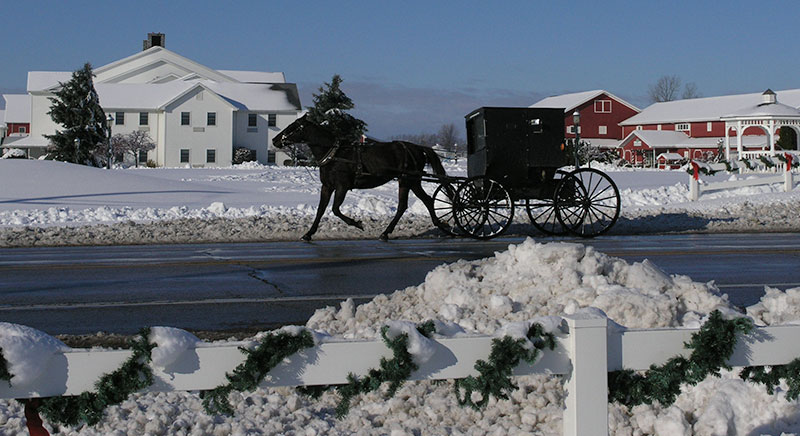
A common sight in LaGrange County.
Image: visitshipshewana.org.

Anabaptists everywhere
Head over to LaGrange County, and you'll see lots of farms with houses and barns painted plain white. If you look closer, you might find some antiquated manual farm equipment strewn across those farms. And in the driveway near the house, you might find a little horse-drawn black buggy taking the place of a car.

This is the land of the Amish, simple folk who live close to the earth and shun most modern conveniences. They're hard-working and generally friendly people, but please don't take their pictures without asking -- they take the biblical prohibition on graven images very seriously.

Most people think of Pennsylvania or Ohio when they hear about the Amish, but LaGrange County is home to the third largest Amish community in America, making up about one-third of the county's population.

We spent a lot of time in LaGrange County when I was growing up. One of our annual family traditions was to take in the Corn School Fair in the town of LaGrange (2010 population 2,625) every October, with its rides set up on the old brick city streets, and side stalls and tents showing off farmers' prized pumpkins and animals. For me, Corn School was always a sign that fall was upon us. I can still feel the chill in the air as I think back to all the flashing carnival lights, the mechanical clatter of the rides, the sweet smell and taste of a big, greasy elephant ear, and the chatter of the fairgoers enjoying themselves. I have fond memories of those days.

The famous
Gohn Bros. catalog.
Image: gohnbrothers.com.
If you like Amish crafts, or just want to people-watch as the Amish go about their daily business, you can't go wrong with Shipshewana. For a very small town (2010 population 658), it's usually bustling with activity. It draws half a million visitors every year, and a lot of them come to see the massive Shipshewana Auction and Flea Market, where you can bid on livestock and antiques or browse the largest flea market in the Midwest.

Ten miles west, in Middlebury (2010 population 3,420), the surroundings look more typically "English," though you will find a notable century-old retail store called Gohn Bros., which specializes in plain clothes for the Amish community, along with quilting supplies and other traditional goods. Their text-only catalog is well known in plain communities around the country, from Amish to Old Order Mennonites to Conservative Quakers. A plain dress, collarless jacket, brimmed hat, or bonnet, tailor-made, is only a phone call away. 

Speaking of Mennonites, LaGrange and Elkhart counties are both home to a sizable Mennonite community. Goshen College, in fact, was the first Mennonite-affiliated postsecondary institution in North America to offer a four-year degree.

Mennonite and Amish life converge at Das Dutchman Essenhaus, a huge restaurant in the Middlebury area that welcomes a quarter-million visitors every year. The Essenhaus employs lots of Amish and Mennonites, serving up tasty Amish-style food to its hungry guests.

In the Middle of it all
Middlebury has a lot going on for such a small town. In addition to Gohn Bros. and the Essenhaus, it's home to a quaint rural B&B called The Patchwork Quilt; Culver Duck Farm, one of the nation's largest duck producers and growers; and Coachmen, a leading maker of recreational vehicles.

RVs as far as the eye can see. Image: doityourselfrv.com.
Speaking of homes on wheels... 
Elkhart is the Detroit of RV manufacturing. Some 80% of global RV production is tied to Elkhart and the surrounding area. My dad worked in an RV plant before he retired, and I worked there with him during summer breaks when I was a teenager. And it's not just RVs that keep the economy booming -- the area also builds lots of manufactured and modular homes. If you see half of a double-wide house zooming down the highway on the back of a semi-truck, yellow caution lights flashing and a prominent "Wide Load" sign on display, there's a good chance it came from somewhere in Elkhart County.

Part French, part Irish, all Catholic
You know how Vatican City is its own miniature country surrounded by a larger city? Notre Dame is sort of like that. The university sits adjacent to South Bend, yet it's technically its own separate entity, complete with its own post office and ZIP code, its own fire department, and its own water supply and power plant. It's a fairly self-sufficient place, and of course it's one of the leading universities in the United States, complete with a picturesque campus and a world-famous football team.

Aerial view of one of the most picturesque college campuses
you'll ever see. Image: commonwealmagazine.org.
It's almost impossible to believe its humble origins, given Notre Dame's international fame today. Along with eight French and Irish brothers from the Congregation of the Holy Cross, Father Edward Sorin, himself born in France, established a new school in 1842, centered on an old log chapel that had served as a mission to the Potawatomi peoples. Two years later, the school was christened as the University of Notre Dame du Lac -- or, in English, the University of Our Lady of the Lake. The campus is situated along two lakes, appropriately named St. Mary's and St. Joseph's. A century and a half later, a Holy Cross priest still serves as the university president, and religious life remains strong, with a meditative grotto made to look like the one in Lourdes, France, a gorgeous basilica, and, naturally, the statue of Mary, Our Lady herself, perched atop the famous Golden Dome of the Main Building.

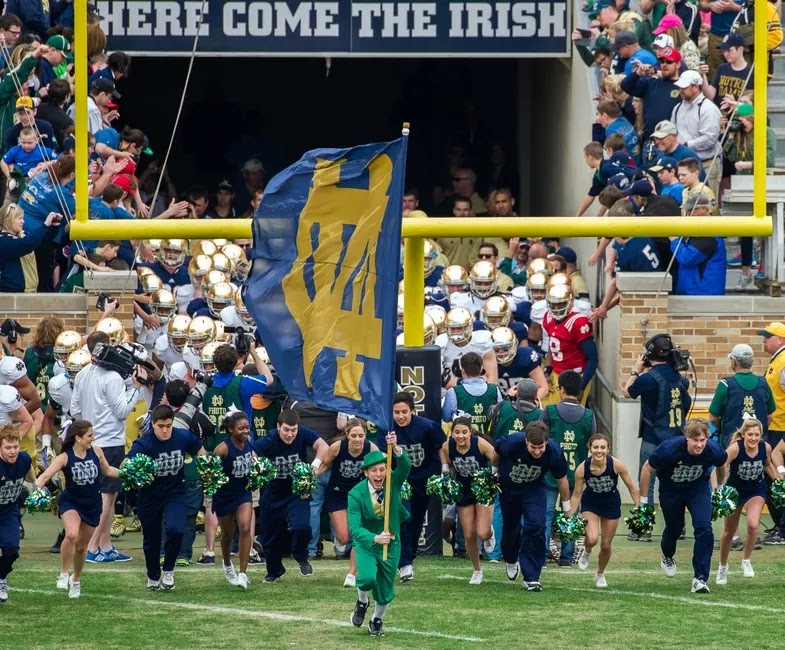
Here come the Irish! Image: fansided.com.
The football team is, of course, iconic, having won 11 consensus NCAA national championships and laying claim to the highest winning percentage in NCAA history. From Knute Rockne to the Gipper to Rudy, the names associated with Fighting Irish football are virtually synonymous with college football itself.

Notre Dame is where I wanted to go to college. When you grow up less than an hour away from Notre Dame, in a Catholic family that loves football, nothing else really compares. But financially speaking, Notre Dame wasn't in the cards for me. Western Michigan University in Kalamazoo was far more affordable, and though I have no captivating memories of my time there, WMU provided me with a decent education and set me on the path toward my current career.

It all began with the Kalamazoo Gazette, which let me get a foot in the door as a freelance reporter, writing feature articles and covering the village council and school board meetings in my hometown of White Pigeon. My work for the Gazette led to similar gigs with the Sturgis Journal and South Bend Tribune, and the Tribune gig eventually turned into a job on the copy desk. I've been earning my keep as a copy editor ever since.

But even though I didn't get to attend Notre Dame, I eventually got to do the next best thing, which was working on campus, as an editor in the publications department. I loved being able to wander the campus grounds on my work breaks, and the discounted season tickets to home football games were a nice perk, too. I'd still be at Notre Dame had my position not been eliminated in a departmental reorganization. It was a dream job.

On the other hand, my job loss there pushed me out of my Michiana-Plus nest and off to new parts of the country. Had it not been for losing my job at Notre Dame, my wife and I never would have had the chance to experience the D.C. area, and I wouldn't have landed a job with the company that I'm still affiliated with as a contractor some 15 years later. So who knows what's good or bad?

Land o' lakes
Because I was adopted and raised by my maternal grandparents, the man I knew as my big brother was, biologically speaking, my uncle. And while we were never terribly close, he never felt more like a big brother to me than when he took me out fishing in his canoe. That was when he owned property on a lake in Syracuse, down in Kosciusko County. That county is home to more than 100 lakes, making it a quaint getaway location that most people don't even know about. I learned how to ice skate on my brother's lake, too. For a brief moment, I thought maybe I could become the next Eric Heiden and win Olympic gold. Now, my gimpy old ankles couldn't even support my weight in a pair of skates. Ah, where does our youth go?

Vandalia, a historic stop on the Underground Railroad.
Image: villageofvandaliami.com.
The Quakers and the Underground Railroad
Cass County was a hotbed of abolitionism in the years before the Civil War. Aided by Pennsylvania Quakers who helped settle Penn Township, the area became an important hub on the Underground Railroad -- so much so that angry planters from Kentucky led an invasion into Cass County, in an attempt to capture escaped slaves who were beginning to inhabit the area. Although the raids failed, as local residents angrily repelled the invaders, the incident helped fuel the passage of the Fugitive Slave Act.

Still, the locals resisted, and a route from Niles, on the eastern edge of the county, to Cassopolis, the county seat, remained a prominent route on the Underground Railroad, with the still-existing Bonine House serving as a central lookout point. A network of Quaker abolitionists in Schoolcraft and Battle Creek helped blacks escape through Detroit and into Canada if they chose to venture past Cass County, but many chose to stay behind and create their own communities. The tiny town of Vandalia, 2010 population a mere 301, was at the epicenter of abolitionist activity in Cass County and today remains around 48% black. The Quakers, regrettably, have vanished from the area.

Businesses past and present
Long before Pete Buttigieg made a splash in the presidential race, South Bend was known for making cars. Studebakers, to be precise. The Studebaker company survived for a little over 110 years, starting out in the 19th century as a maker of buggies, wagons, and carriages before moving on to the horseless carriages that propel us around today. But its fortunes faltered in the post-World War II years, as Ford and GM undercut each other to win over suburban America. By the mid-'60s, auto production had ceased and the company, for all practical purposes, was no more.

But the South Bend area still produces vehicles today. In nearby Mishawaka (2010 population 48,256), the AM General plant builds both civilian Hummers and military Humvees.

A few miles further east, Elkhart is still home to Selmer, which means that if you played a musical instrument in school, there's a good chance it has a Michiana connection. Selmer is now Conn-Selmer, which itself is a subsidiary of Steinway, the piano people.

What's not in Elkhart anymore is Miles Laboratories, the onetime maker of Alka-Seltzer, Bactine, and Flintstones and One-a-Day vitamins. Bayer bought the company in 1979 and relocated its headquarters to Pittsburgh in 1992, before retiring the Miles name three years later.

Kalamazoo Mall, the first pedestrian mall in America.
Image: downtownkalamazoo.org.
Medicines have also played a role in Kalamazoo's history. The city was once home to Upjohn, which has since become part of Pfizer. The latter still maintains a presence in Kalamazoo and neighboring Portage (2010 population 46,375), along with Zoetis, an animal health company that Pfizer spun off around 2013. Kalamazoo is also home to med-tech company Stryker.

But Kalamazoo has lost what Elkhart still has -- musical instruments. Gibson, the guitar company, was born in Kalamazoo, but it was bought by an outside company in 1944. Thirty years later, production began to shift from Kalamazoo to Nashville. By 1984, production in Kalamazoo was no more.

Kalamazoo is also notable for its open-air Kalamazoo Mall. It was the first pedestrian mall in the nation when it opened in 1959.

And then, of course, there are the local and regional companies that, if you know about them, mark you as coming from that part of the country. Everyone in Michiana, for example, knows Martin's Super Markets. And for anyone who grew up in West Michigan, your superstore/hypermarket destination of choice wasn't Walmart, but Meijer -- pronounced like "Meyer," but with no connection to the Pacific Northwest's Fred Meyer stores.

Image: swissvalley.com.
Skiing in corn country, rafting in the city, and other hidden (and fading) gems
Swiss Valley, near unincorporated Jones, Michigan, is a delightfully unexpected find. In the midst of mostly flat farmland, you'll find 11 ski runs, chair lifts, and a 225-foot peak, the tallest in all of southwest Michigan.

You also might not expect to find Colorado River-quality rapids in the middle of a city. Yet that's just what you'd encounter on the East Race Waterway in South Bend. Built on the St. Joseph River, it's the first artificial whitewater course in North America.

If you really love county fairs, why not check out the second largest one in the United States? The Elkhart County 4-H Fair is hard to beat.

See how Amish farm life looks when it's turned into, well, a meticulously groomed tourist trap. Amish Acres in Nappanee (2010 population 6,448) has lots to offer in a picturesque farm setting that also features a performance theater, lodging, food, and craft demonstrations.

For those needing a little culture, South Bend and Kalamazoo lead the way with an abundance of museums, celebrating everything from art and history to automobiles and aviation. If it's entertainment you need, Notre Dame's Joyce Center and Kalamazoo's Wings Events Center are home to concerts and sporting events. And there are festivals everywhere you turn, from the homey little White Pigeon Days fair I used to enjoy, to the Apple Festival in Niles, to classier experiences like the Elkhart Jazz Festival and Kalamazoo's Gilmore Keyboard Festival.

But while lots of the area's traditions survive, others have faded away -- like the annual Tomahawk Game that defined the sports rivalry between White Pigeon and Constantine for over 80 years. And on another sad note, a little-known but highly prestigious Michiana school has reached the end of its life. Howe Military Academy, a private LaGrange County boarding school for grades 7 through 12, has closed its doors after 135 years. A combination of rising costs and dwindling enrollment sealed its fate, and the campus is currently up for sale.

The Wings on green ice. Image: kwings.com.
Second fiddle to the big leagues
Somebody has to play in the minor leagues, and the region I hail from offers fans a few opportunities to catch some fun minor-league action at decent prices. For baseball fans, there's the South Bend Cubs, formerly the Silver Hawks. Not surprisingly, the single-A Midwest League club is a farm team for the Chicago Cubs.

Up in Kalamazoo, hockey fans can catch the Kalamazoo Wings, an ECHL club affiliated with the NHL's Vancouver Canucks and the Utica Comets of the American Hockey League. And here's one of the things that make the minor leagues so much fun: The Wings have a long-standing tradition of playing on green ice for St. Patrick's Day. I once took my wife to a pink-ice Wings game on Valentine's Day. You'll never see that in the NHL.

Perhaps you've heard of us
From South Bend to Kalamazoo, the region has produced a few famous people over the years. Here's a partial list.

Brendan Bayliss, singer and guitarist for Umphrey's McGee -- born and raised in South Bend
Lindsay Benko, Olympic gold medalist and former swimming world record holder -- born in Elkhart
Harry Blackstone Jr., magician -- born in Three Rivers
Tom Bodett, the voice of Motel 6's "We'll leave the light on for you" ads -- raised in Sturgis
Marian and Vivian Brown, twin actresses -- born in Kalamazoo, raised in Mattawan
Jake Cinninger, guitarist in Umphrey's McGee -- born and raised in Niles
Schuyler Colfax, U.S. vice president under Ulysses Grant -- lived in South Bend
Candy Crowley, CNN news reporter -- born in Kalamazoo
D'Arcy, former Smashing Pumpkins bassist -- born and raised in South Haven
Vivica Fox, actress -- born in South Bend
Peter Gent, former NFL player and author of North Dallas Forty -- born and raised in Bangor
Lisa Germano, musician, born in Mishawaka
Jon Gruden, NFL coach -- raised in South Bend
Ernie Hudson, actor -- born and raised in Benton Harbor
Tommy James, musician -- raised in Niles
Derek Jeter, baseball great -- grew up in Kalamazoo
Shawn Kemp, former NBA player -- born and raised in Elkhart
Ring Lardner, writer -- born and raised in Niles
Loretta Long, best known for playing Susan on Sesame Street -- born in Paw Paw
Ed Lowe, inventor of Kitty Litter -- raised in Cassopolis
Pete Metzelaars, former NFL player -- born in Three Rivers
Sinbad, actor and comedian -- born and raised in Benton Harbor
Matt Thornton, major-league pitcher -- born in Three Rivers, raised in Centreville
Verne Troyer, best known as Mini-Me from the Austin Powers films -- born in Sturgis, raised in Centreville
Kate Upton, model and actress -- born in St. Joseph
Narada Michael Walden, musician -- born in Kalamazoo

Thank you all for coming. Please watch your step on the way out.

For me, this has been an enjoyable trip down memory lane. For you, I hope it's been entertaining and informative. A third installment, detailing our family's impending encounter with small-town life, will be coming soon.

(Part 3: Moving on to Wallace, Idaho.)

Sunday, August 18, 2019

Small-Town Memories; Small-Town Future. Part 1: Growing Up in White Pigeon, Michigan.

Kalamazoo. South Bend. Three Rivers. Elkhart. Constantine. Bristol. Mottville. Shipshewana. Sturgis. Goshen. Portage. Mishawaka. Niles. LaGrange.

White Pigeon.

These are the place names that will forever be stuck in my consciousness. They're the names I grew up with, the places that shaped me. Its churches, corn fields, Amish buggies, RV factories, stores, and schools were the backdrop for my childhood, teen years, and early adulthood.

Why do I expect you to care? I don't. But it's important to remember our roots and reflect on the people and places that served as our early windows to the world, that shaped our values, our likes and dislikes, our personalities. Maybe those places nurtured us, or maybe they spit us out. Maybe we still live there, or maybe we chose to venture out into the bigger world. But those places are forever an integral part of us either way.

And since our family is planning a move from the big city to a small town, I thought it might be an appropriate time to reflect on what small-town life is like. It might be a shock to my soon-to-be 8-year-old to make such a drastic change, in ways she can't fathom yet. It might even be a shock to my wife, who grew up in the Detroit suburbs, lived with me in the greater D.C. area, and has called suburban Seattle her home along with me for the past nine years.

I was born in a small town... 

The land office, still standing,
now on the National Register
of Historic Places.
Photo: Wikipedia.
I was raised by my maternal grandparents just outside the bustling metropolis of White Pigeon, Michigan -- population roughly 1,455 when I came into the world. My grandparents adopted me, so I only ever knew them as Mom and Dad, and that's how I'll refer to them here.

White Pigeon's greatest distinction lies in its historical importance. Situated a few miles north of the Indiana state line on the old Sauk Trail, roughly halfway between Chicago and Detroit, White Pigeon is the oldest incorporated village in Michigan and served as an important crossroads, a resting spot, and a small oasis of civilization in the frontier wilderness as far back as the 1820s. A land office opened in White Pigeon and began selling ceded lands from the Potawatomi peoples for $1.25 an acre in 1831. Around 250,000 acres were sold out of that office, making it the central point from which pioneers began to settle Southwest Michigan.

I wouldn't say White Pigeon is a train wreck of a town,
but it was the site of a pretty spectacular locomotive
collision in 1901. Remarkably, no fatalities.
Photo: Kalamazoo Gazette.
The village was incorporated in 1837 and soon became an important stop on the railroad. The rail was supposed to pass through Constantine, the next village to the north, but the residents of White Pigeon caught Constantine sleeping and successfully lobbied to get the line for themselves. That sleight of hand proved to be serendipitous, as a branch line was later built to satisfy the original stipulations that the railway had to meet both Constantine and the St. Joseph River, which winds through the entire region and flows through downtown Constantine. That line was extended into the abundant woods around Grand Rapids, which supplied both lumber and furniture to the region, and thus did White Pigeon become the junction point between lines that ran between Chicago and Toledo to the west and east, and Grand Rapids to the north.

So important was White Pigeon to the developing region that it became home to a grand hotel, the Kingsbury, that housed weary railroad travelers. It was said to be one of the most elegant lodging places in the entire state, even surpassing anything Detroit could offer at the time.

The long-gone Kingsbury Hotel.
Photo: St. Joseph County
Historical Society.
The town's one small brush with fame came about when Republican presidential candidate Wendell Willkie was conducting a whistle-stop tour on his 1940 campaign. His train pulled in to the White Pigeon depot, and he slept there overnight in his sleeping car.

That's about as exciting as it gets in White Pigeon. It's well past its heyday now. Although it's still a notable crossroads between bigger faraway places, with east-west US-12 and north-south US-131 intersecting just west of town, its already modest fortunes began to fade when trucking and air travel diminished the importance of the railroads by the mid-20th century. The Kingsbury Hotel is long gone, and White Pigeon's depot, which sat empty and in disrepair for decades, today has been restored and serves as a public meeting place, preserving a link to the town's past.

My enduring memories of White Pigeon are more places than people -- probably because I was never a popular kid, and in a small town, either you're in the clique or you aren't.

Kalamazoo Street, looking south.
There was the old Sun Theater, where I saw Star Wars with my parents when it first came out in 1977. Last time I went home for a visit, the theater had been converted into a church.

There was our small, humble library, where I rifled through the card catalog to see what interesting books I could find and take home to read; and the post office right next door, where my family's bills and letters would find their way out to the larger world.

There was Troyer's IGA (later Supervalu), where I'd tag along and play the sole arcade game just inside the entrance while my parents shopped. The game console changed over the years, but I remember playing Pac-Man, Qix, Wizard of Wor (a game that talked to you -- that was really something in the early '80s), and maybe Galaga, but I'm not sure about that one anymore. 

Once my dad's service station,
then a pizza joint.
Now... probably empty.
There was my dad's service station, on the corner of US-12 and Kalamazoo Street. He was a mechanic, and it had always been his dream to open his own shop. While he was a good and trusted auto repairman, he went into business at a bad time, during the recession of the early '80s. He soon went back to working for other people, while the service station eventually was converted into a pizza shop. As far as I know, it sits empty today.

There was Pigeon Inn, the restaurant and bar right next door to my dad's old station. It was a total dive, but their chicken dinners were consistently delicious, and I always enjoyed plugging quarters into the jukebox while we ate. Happily, Pigeon Inn is still open for business after all these years. Word has it that some scenes were shot inside Pigeon Inn for an indie film called Fawn River, due out sometime in 2019.

Pigeon Inn.
There was, along the main drag of Kalamazoo Street, little family-owned Wittenberg Hardware, where my dad would buy things he needed for repairs around the house; Village Video, a little mom-and-pop where we rented VHS tapes for the night; and Roy's, a tiny convenience store where my best buddy and I would take all the bottles and cans we could find, cash them in for the 10-cent refunds, and blow our riches on penny candy. 

There was Burgess Drug, run by an odd, cranky old guy who didn't seem to like kids. That old drugstore was empty last time I went home. Roy's and Village Video are long gone, too, and I don't think the Wittenbergs own the hardware anymore, if there even still is a hardware.

There was the town doctor, and by that I mean the town doctor. He was the only one. He was a D.O. and had a gruff bedside manner. But he knew what he was doing, and to the best of my memory, he always fixed us up right whenever we needed it.

The Tasty Nut Shop (and Soda Bar).
There was the Tasty Nut Shop. If White Pigeon is still regionally known for anything, it's probably the Nut Shop. But for some reason, I never set foot inside it, in all the years I lived there. They boast of "nuts from all over the world," the largest assortment of toasted nuts in the United States, and an honest-to-goodness soda fountain, straight out of the 1950s. I finally popped in to check the place out a few years back. It's worth your time if you're ever passing through.  

St. Joseph Catholic Church.
There was St. Joseph Catholic Church, out on the east end of town. Although my parents often visited other Catholic churches around the area, St. Joe's was our home base. That's where my faith was formed. It's where I was baptized and had my first confession and communion. And it's eventually where I was confirmed. We were too small to have our own priest, so we had to borrow priests from neighboring parishes. They'd drive in to celebrate Mass on the weekends, working around the Mass schedules of their home churches, while St. Joe's was overseen day to day by Sister Max, a tiny little lady who was full of energy and as kind as you'd expect a sister to be, yet politely stern when the situation called for it. 

The concession stand, overlooking
the field where the football team
used to play.
There was Central Elementary School and White Pigeon High School. I had good times, bad times, and awful times there. My favorite memories are associated with the football field, where I'd watch our team play on Friday nights. 

The most anticipated game of the year was when we played our arch-rival, Constantine, for the right to claim a tomahawk that a farmer had plowed up in a field between the two towns. After more than 80 years, the Tomahawk Game ended in 2007, when Constantine joined a new football conference, thus ending one of White Pigeon's oldest and greatest traditions. 

In high school, as first-chair percussion, I played snare drum on that field with the marching band during halftime of the football games. But long before that, as my dad and I sat in the stands one Friday, drinking hot chocolate on a bitter, rainy fall evening in 1980, we heard the PA announcer call out the number on the $1 raffle ticket we'd bought. Our prize was a football signed by all the members of the football team. It was quite a special ball, too, as that happened to be the year our team advanced all the way to the state championship -- where we lost to a team from Munising, way up in the wilds of the Upper Peninsula. 

To this day, that football is the only thing I've ever won. I donated it years ago to the high school, where, as far as I know, it still sits in a showcase display.

And finally, there was the house I grew up in -- a beautiful old 19th-century brick Italianate-style house that towered over the surrounding fields about a mile south of town. My family told me it was built by a retired Civil War general. My parents always had high hopes of restoring the place to its original grandeur and never quite succeeded. But that didn't matter. It was still home, with all its flaws. I'd sit with my mom and our dogs on summer nights in our ramshackle back porch, music playing on the console stereo, while we watched the fireflies flickering their lights in a private fireworks display. On spring and summer days, when we got tired of listening to music or playing Atari 2600 games, my best pal and I would sometimes climb out the cupola windows, sit on the roof of my house, and look out over the countryside. Or we'd ride our bikes down the dirt paths that cut along our property line and back into the fields. We'd hunt for wild berries, explore the old corn crib that belonged to the farmer next door, and hang out on the concrete slab that was all that remained of a long-gone farm building.

From my room, with the window open at night, I could hear, accompanying the chirping crickets, the droning hum of the paper mill that lay about a mile away, past the fields and trees, on the very south end of White Pigeon. It was comforting in its own strange way -- as was the click-click-click of the center-pivot irrigation machine that watered the corn across the street. I always looked forward to the summer nights when the irrigation would swing around to our side of the field and lull me to sleep. It was a bonus whenever we'd get a spectacular thunderstorm, with the thunder rumbling and the rain pattering down outside.  

The Blizzard of '78. That's really what it looked like.
Photo: WOOD-TV.
Winters could be harsh out there on the open prairie. The upstairs of our house got so cold in the winter that we had to put salt in the toilet to keep the water from icing up and cracking the porcelain. Wind chills could reach 40 below, while lake-effect snow caused white-outs and could unexpectedly dump inches and inches of snow in a single day. If you ever got caught driving in that kind of snow, you had to learn really quickly how to brake without spinning out of control, and to stick to the divots that the cars ahead of you created.

Snow was just a given in the winter. I was born in a blizzard, I'm told. The most intense winter storm I can remember came in early 1978, when we got buried under three feet of snow in about a week's time. Even in a part of the country where hardy people shrugged off the snow and we had plenty of plows to keep the roads passable, the '78 blizzard paralyzed our region for days. My most enduring memory of that storm was the day my dad, craving nicotine, trudged through waist-deep snow across the fields to White Pigeon, a good mile away, to buy a pack of Winstons. That's either determination or insanity. But he was a two-pack-a-day smoker, and I guess you do what you gotta do.

And oh, by the way, the house was haunted. We all saw and heard things we couldn't rationally explain, even visiting friends, neighbors, and family members. The house eventually became too much of a burden on my aging parents, and the man who bought it from them sank a lot of money into restoring and remodeling it to turn it into a bed-and-breakfast -- but he didn't stay in business long. I always wondered if too many things went bump in the night and scared away the guests.

I went back to visit my old house a few years ago, having never seen the interior since it was renovated. I barely recognized it. Walls had been torn out, bedrooms had been given adjoining baths, the kitchen had been expanded ... it didn't look like the house I grew up in. The family that lives there now seems to have taken good care of it, but I guess it's true when they say you can't go home again. The home I knew there no longer exists.

So what's with the name? you're wondering. Why White Pigeon? Well, our little town was named in honor of a Potawatomi Indian chief, whose name, Wahbememe, translates to "white pigeon." The chief had befriended the white settlers in the region. When he was attending a meeting of chiefs in the Detroit area around 1830, he overheard plans to invade and attack the settlers where he lived. The chief left the conference, and according to the legend, he ran, nonstop, for the entire 150 miles, so he could warn the settlers. After returning and delivering the news, he died of exhaustion. In gratitude for saving them, the settlers named their town White Pigeon in his honor. A historical marker lies just west of town, marking the approximate spot where he died.

With that in mind, while naming sports teams after American Indians has become somewhat controversial in recent years, White Pigeon offers a case in which naming its school teams the "Chiefs" was more an act of thanks than one of appropriation.

So is it good or bad to live in a small town? Well, on one hand, you almost always have people looking out for you, and it's much easier to get to know people personally. On the other hand, it can be hard to break in if you move there from someplace else, and everyone knows your business. If you value privacy and anonymity, you'll struggle in a small town. If you value community, and provided the community accepts you, small towns can be great.

Growing up in White Pigeon, I was a loner and had a very small circle of friends, all of whom but one I almost never saw outside of school. But people knew me because they knew my dad, and it's anyone's guess what they thought of me or said about our family when we weren't around. I just kept to myself, hung out with my best buddy, and made the best of things. There were bullies and cliques in high school, but really I felt that most people were indifferent to me outside of school. And the feeling was mutual.

Like I said, my best memories are of the places, and not so much the people. You make the best of your situation, and that's exactly what I did.

(Part 2: Life in Michiana-Plus.)

Sunday, May 5, 2019

How the Left Lost Me for Good

From the film 1776.
There's a scene in the musical film 1776 where the members of the Continental Congress are voting on whether to proceed with debate on drafting a declaration of independence from Britain. The vote is tied, and the Congress awaits the return of Stephen Hopkins, the delegate from Rhode Island. When he's informed that the deciding vote rests on his shoulders, Hopkins addresses the Congress:

Well, in all my years, I ain't never heard, seen, nor smelled an issue that was so dangerous it couldn't be talked about. Hell, yeah! I'm for debating anything. Rhode Island says yea!

Those who had been waiting for ages just for the chance to debate independence erupt into celebration.

Now, it's doubtful whether the real Hopkins ever spoke those words, but they do telegraph something important about the founding American spirit: the ideal that our right to free expression is sacred.

Fast-forward a few centuries, and America looks a whole lot different:
  • Students at the University of the Arts in Philadelphia are seeking to fire Camille Paglia, a pioneer of feminist thought and sexual politics, for saying things that don't conform to the students' ideology. They were demanding that the woman with over 30 years of tenure be replaced by a "queer person of color" -- as if pigmentation and orientation trump any other consideration. In the mind of the modern left, given its obsession with identity politics, they apparently do.
  • At Evergreen State College, professor Bret Weinstein criticized a plan to have all white people leave the campus for a day. For doing so, protesters harassed and threatened both Weinstein and the school, forcing the college to temporarily shut down and causing over $10,000 in damage to campus, while Weinstein was forced to hold his class in a park because campus police told him they couldn't ensure his safety. 
  • Both Ann Coulter and Milo Yiannopoulos were forced to cancel speeches at Berkeley, once the home of the Free Speech Movement, because of threats of violence in Coulter's case, and actual violence in Yiannopoulos' case.
  • Antifa protestors block a city street in Portland, ordering drivers to turn while verbally assaulting them, including calling one driver from South Carolina a member of the KKK, apparently simply for being white. All this while the cops look on and do nothing.
  • A 72-year-old Russian Orthodox priest who lives in a monastery in the Seattle area was filling up his car at a gas station, when a man walked up to him, asked "How's Trump?," and then cold-cocked the priest in the head. 
  • Students "traumatized" by a mural in a San Francisco high school want it removed. The 83-year-old mural depicts George Washington along with slaves and Indians portrayed in an unflattering light.
  • The University of Notre Dame has decided to cover a series of 130-year-old murals depicting Christopher Columbus' arrival in the New World, because they may be offensive to indigenous peoples.
  • The Philadelphia Flyers stopped playing Kate Smith's rendition of "God Bless America" during its hockey games and first covered over and then removed her statue outside the stadium, after it came to light that she sang two songs 80 years ago that contain questionable content relating to black people.
  • The Washington Post ran an editorial advocating for the arrest and imprisonment of families who choose not to vaccinate their children.
  • The Poynter Institute has compiled a list of over 500 conservative-leaning websites that it advocates shutting down -- for being "unreliable" sources of information.
  • A group of kids from a Catholic high school, enjoying their visit to D.C., were framed by the media as racists based on a short video in which a young man, wearing a pro-Trump "Make America Great Again" hat, stands face to face with an Indian activist banging a drum at him. Only after the outrage mob went into full force was the full context revealed -- the kids had been taunting a group of racists when the Indian activist marched up into the kid's face, supposedly to try to defuse the tense situation. The kid, understandably, is a bit nonplussed over the whole thing, but the media instantly interpreted his reaction as a smart-alecky, privileged, racist smirk. The hate from the "tolerant" left kicked into full gear before the full story was ever in, with at least one good "liberal," Disney film producer Jack Morrissey, going so far as to suggest the kids should be put through a wood chipper. 
  • A social-media mob forced Mozilla's CEO to step down because he made one contribution to a movement supporting the now-overturned gay-marriage ban in California.
  • Actor Kevin Sorbo, who is politically conservative, was blacklisted from a comic-book convention -- for being politically conservative.
  • Activists are preparing to force Mastercard to deny credit access to people based on their conservative political views. 
  • And now, following a systematic takedown of people with views that challenge the establishment, Facebook has silenced Alex Jones and Yiannopoulos on flimsy charges of abusing the platform. Facebook has gone one step further with Jones, promising to ban anyone who shares Jones' material, unless they accompany the share with a statement that they denounce Jones. In other words, don't commit what George Orwell referred to in 1984 as a thoughtcrime. You may only express negative opinions of Alex Jones. The Ministry of Truth has spoken.

Photographic evidence of Stalin airbrushing his enemies out of history.
This is the face of the modern political left -- an authoritarian mob that would rather scrub history, Joseph Stalin-style, than take the time to educate people about how values were different in past times. These are people who would prefer to disappear old paintings, monuments, and now even entertainers for committing thoughtcrimes, by applying contemporary mores and values to past eras and expecting people from those eras to conform to how we think now, rather than use those past views as teaching moments so that we don't repeat history.

For some reason, I can't help being reminded of the Taliban members in Afghanistan who destroyed the ancient Buddha statues carved into a mountainside. It's the exact same impulse we see today from a deranged political faction that demands absolute moral purity according to its own standards.

The left once championed free speech. Now it demands you conform. And if you don't, you'll be bullied, threatened, harassed. You might be doxed. You may lose your reputation and your livelihood.

In short, you will be silenced and destroyed. They're not interested in your apology for violating their politically correct views. They might enjoy seeing you grovel, but their end goal is your annihilation.

"Tolerant" "liberal" Sarah Jeong, NYT employee.
Forget any sympathy if you're a straight white male, because the left has taken old racist attitudes and simply turned them around, as if two wrongs make a right. Just ask Sarah Jeong, whom The New York Times hired to be a part of its editorial board, despite Jeong's history of engaging in hate speech on Twitter against whites. When she was called out, the Times doubled down in support of their new addition, who once said: "White people have stopped breeding, You'll go extinct soon. That was my plan all along." That, accompanied by the hashtag #cancelwhitepeople. You can imagine the firestorm -- which would be well deserved -- if someone replaced "white people" with "black people" or "the Jews."

Indeed, in the minds of these neo-fascists, "straight white male" is the new Juden. It's as if, instead of walking into a Southern diner in the 1950s and seeing a "whites only" counter, the new left has installed a counter saying "everybody but whites welcome."

Little wonder, then, that the NYT could run an article actually asking if a white man should be the Democratic presidential nominee. If anything proves how upside-down the left's worldview has become, that's it right there. Not only does it reveal the left's hatred of white people, but it also exposes how they make appearance their most important consideration. Consider how much the left is currently enamored with Pete Buttigieg, apparently because he's articulate and gay, but then leftists start wringing their hands wondering whether he's "gay enough" -- because he's also white and male and may have benefited from too much "privilege" in his lifetime.

So even being part of one of the left's cherished identity monoliths isn't enough, if it's possible you haven't been oppressed enough.

Straight white male bad. Beep, boop.
But never mind all that, because, in the minds of the intersectional identity groups participating in the Oppression Olympics, where perpetual victimhood is a virtue, it's impossible to even be racist toward white people. You have a license to hate. Rather than take a world where the tables have been historically tipped against certain groups and attempt to level the playing field, their solution is to simply tip the playing field in the opposite direction. In their minds, two wrongs truly do make a right. Their brains are fixated on revenge, not reconciliation.

And that's because these people see humanity in monolithic groups rather than as individuals. That's the cornerstone of their identitarian groupthink politics. So there can't possibly be a decent straight white guy out there. They are all one, and they are all bad. Stereotyping an entire group is the textbook definition of racism, but never mind that. Their Borg-like hive minds can't do otherwise. (There's a reason the NPC memes irritate the left so much. They hit too close to home. It's also why the left can be so easily trolled into thinking that things like making the OK sign or drinking milk is secret Nazi code -- or that Russians won the election for Trump. Groupthink undermines critical independent thought.)

But, again, you don't even necessarily have to be a white male to be hated. You can also forget any sympathy from the left if you're a member of an identity group the left champions but you don't hold the correct political views. The left is all about looking different, it seems, but not about thinking different. Just ask Candace Owens, a black woman, who, with her breakfast companion, Charlie Kirk, was attacked by an Antifa group in Philadelphia. Listen to them chant "fuck white supremacy" -- at a black woman. 


Even if you're black, you're an un-person in the minds of those people if you hold the "wrong" views. Heck, you're literally Hitler.

It's quite notable that Facebook claimed to throw Alex Jones and others off its platform for being "dangerous." Yet Antifa, which actually commits violence against people in real life, remains on Facebook, as do people and groups who post death threats to President Trump and to critics of transgender politics. In fact, people who have the audacity to point out the biological fact that men are men and women are women are deplatformed, fined, fired, or even visited by the cops. Because now, how you feel carries more value than science. While the right has climate-deniers, the left now has people insisting that women can have a penis and men can have a period, because all that matters is how you "identify" -- as if you can just pick your biological makeup off a rack, like choosing a new pair of clothes. And then you can demand that others recognize your pronouns, whether "he," "she," "they," or some made-up concoction, with the ever-looming threat of social ostracism if you don't comply.

If this isn't the height of raging narcissism, I don't know what is.


And that doesn't even touch on the problem of men who invade women's spaces by "identifying" as one of them.

So the fact that violent extremists are still allowed to be on Facebook puts the lie to the company's rationale for kicking out Alex Jones and company. Because what's really happening here is payback for 2016. The establishment elites are terrified that they're losing their hold over the populace, so any views that challenge their hegemony are being silenced. They don't care if they have to sacrifice American values to do it, either.

We've seen this in the media for ages, of course...
  • Propaganda reigns. The media says John McCain is a hero and a saint, despite being one of the biggest warmongers and enemies of civil liberties the Senate has ever seen, and the public follows right along, like sheep.
  • Julian Assange is arrested and awaits possible extradition to the United States, and the media's reaction is to smear him, while the gullible public plays right along. Never mind that Assange's mission was only ever to reveal the truths that our governments won't tell us about. Assange and WikiLeaks wouldn't even be necessary in a world where journalists actually did their job.
  • Russiagate was revealed to be a hoax, which anyone who didn't let emotion hijack their critical-thinking skills could have seen all along. It was never anything more than a DNC-concocted diversion from the content of its leaked emails showing how the Democrats cheated Bernie Sanders out of the 2016 nomination and how Hillary Clinton's people worked with the media to promote Trump as a pied-piper candidate for the far right. Yet without any evidence, anyone who disagreed with the left or said anything remotely complimentary of Trump was smeared as a "Russian bot." And now that the investigation is complete, people still can't let go of the idea that Vladimir Putin somehow stole the election for Trump -- rather than just admit that the Democrats' plan to promote Trump blew up in their faces.
  • People refuse to let go of the idea that Trump was elected because of a racist temper tantrum. They ignore the pain of the poor working-class people who have been marginalized and forgotten as neoliberal economic policy has destroyed their way of life. Rather than listen to their concerns, the elites simply dismiss them as ignorant racist hillbillies. 
  • The establishment pumps up Joe Biden, a neoliberal corporate Democrat, while continuing to slime Bernie Sanders. It's doing the same thing to Tulsi Gabbard, for daring to question our wasteful and murderous foreign policy. Make no mistake: The establishment Democrats would probably rather cede the 2020 election to Trump than to let a progressive become its nominee. They want control back. They already control the public narrative. Now they want the power of leadership to go along with it. They want to continue to promote the disastrous policies that led to Trump's election in the first place.

I can't really say I've been red-pilled. I don't like right-wingers. I think they're mean and uncompassionate, too jingoistic, too willing to settle matters with violence, and too willing to unquestioningly defer to authority figures. And when you venture out into the far-reaching wilds of the right, into the land of the white supremacists, you find people just as ridiculous and as identity-group-obsessed as SJWs. One group blames whites for everything, and the other thinks whites can do no wrong. Both views are equally foolish.

But I just can't align with the left at all anymore, even though I support things like universal healthcare, free secondary education, and a peaceful foreign policy. The left, to put it plainly, has been taken over by virtue-signaling authoritarian dictators who squelch everyone who disagrees with them. I've had friends doxed by these people. They lost their jobs and continue to face threats to their lives and the life of their young daughter. There is absolutely nothing "liberal" or "tolerant" about any of this. To the contrary, it's absolutely terrifying that their attitudes have made it into the political mainstream at all -- every bit as terrifying as if white supremacy itself had been mainstreamed. If you deviate in the slightest from the left's dogma, they will hunt you down and anathematize you. They're fanatical, intolerant fundamentalist witch-hunters without the religion. They don't believe that you have the right to your own views. You must conform to theirs, or you will be de-personed.

But again, remember, you can be violently hateful and it's perfectly OK, as long as you hold the correct political views. Jack Morrissey, the one who advocated throwing teenage boys into a wood chipper for wearing MAGA hats, still has his Twitter account as of now.

This kind of behavior is completely contrary to the values of a free society.

Especially in an intolerant climate like this, when people take Facebook's side on censorship and argue that private companies can do whatever they want, that’s not just a total copout -- it's irresponsible. No company can do whatever it wants, especially when it fails to act in the public interest. When companies are caught using child or slave labor, is that OK because private companies can do whatever they want? When pharma companies jack up the price of life-saving drugs into the tens of thousands of dollars, all while buying back billions of dollars of their own stock to pump up earnings per share for their shareholders, is that OK because private companies can do whatever they want? Of course not.

And in Facebook's case, even Mark Zuckerberg has argued that his company is the equivalent of the modern public square. We're talking about a massive multibillion-dollar corporation that's accountable to no one yet has enormous influence over the public narrative. If it can't guarantee equal access to its services, then it needs to be regulated like a public utility, along with all other social media. If it were some random website with a few thousand followers, that would be one thing. But Facebook controls what people talk about, and it most certainly has an influence over who wins elections. So when it decides which political views to silence, and then demands that its users denounce those views if talking about them, it has crossed an acceptable line.

Of course, in a country like ours where government and corporate interests are so deeply intertwined, what Facebook's doing amounts to state censorship by proxy, a sort of end-run around the First Amendment.

I saw all this coming decades ago, when speech codes started popping up on college campuses. The seemingly innocuous attempt to have people self-police what they say has metastasized into what we see today, with outrage mobs demanding the suppression of free speech. How tragic that college campuses were once the place where young adults went to be exposed to and challenged by new ideas. Now they serve as gigantic "safe spaces" where eternally triggered overgrown children are coddled, and where they cry to an authority figure every time somebody threatens their bubble. How they feel trumps all else, which is why so many of them do nothing but scream down their opponents when challenged, like toddlers throwing a tantrum. They have no logical arguments -- only emotion. And so they deal with things by shutting down opposing views that they lack the tools to refute, whether by drowning out a speaker, threatening violence against the place hosting the speaker, or pulling fire alarms to shut down the talk. The Brownshirts of old would love their tactics.

You don't have to like Trump, for example, to realize that Trump Derangement Syndrome is a real thing. Incoherent screaming is not an argument.


Seriously -- when college campuses arrange for their students to have cry-ins, where they could hug puppies and color with crayons and use Play-Doh, all in response to Trump's election victory, is there any question whether these people are emotionally stunted, and that that's why they act the way they do? They simply can't let go of the reality that it wasn't Russians and racists that elected Trump, but their very own fellow Americans, in response to neoliberal policies that have been ruining poor working-class lives. The policies that they, the deranged, support, by voting for corporate-friendly establishment Democrats. Caught in their own cognitive dissonance, and unable to articulate a response, they scream like children and demand that everyone shut up. And that's if they're not busy actually launching violent attacks on Trump supporters.

"Tolerant" "liberals," indeed.

It seems, then, that we're censoring people, deplatforming them, de-personing them, all because these people hurt the feelings of those who lack both the ability to refute their opponents and the emotional intelligence to allow other people to have views different from theirs. Rather than teach people to defend their views while allowing other people to have their own views, we infantilize them and enable their deficiencies, even at the cost of free speech.

What it boils down to is that the left is afraid of ideas. If they weren't, they'd allow other people to have their say, after which they could have theirs. But no, that's not allowed. Ideology reigns. Groupthink is a given. Oppression is a virtue. And just like with any fanatical religious group, independent thought is regarded with deep disdain. You have to go out and burn the witches to remove any challenges to your ideological purity. And when witch-burning isn't being carried out through harassment and violence, it takes the form of censorship of opposing views. Which is precisely what we're seeing now.

Censorship is how dictatorships operate, not open, free democracies. Free societies allow the free exchange of opinions and let the marketplace of ideas play itself out. I don't need a nanny telling me what I can and can't say or read. I have a brain in my head and can discern good from bad for myself.

I also don't have to like what someone says to recognize their right to say it. The cost of living in a free society is that other people get to say and do things I might not agree with. As Noam Chomsky once said, if we don't believe in freedom of speech for the people we despise, then we don't believe in it at all. Truer words were never spoken.